Last updated November 25, 2026
ADU Cost Breakdown: The Citrus Heights Homeowner’s Reference for 2026
The gap between the lowest and highest ADU bid a Citrus Heights homeowner receives usually isn’t profit margin. It’s line items. One proposal accounts for a sewer lateral upgrade, a new electrical service panel, and the soil work a sloped lot needs. The other leaves those out, quotes a friendlier number, and reveals the real cost once the foundation is already dug. Per-square-foot figures hide all of this, which is why a $/sq ft number is the least useful thing in your stack of bids. What follows is a line-item framework for budgeting an ADU in Citrus Heights in 2026 – hard costs, soft costs, and the carrying costs most guides skip – so you can read a proposal and see what’s missing.
Quick Answer
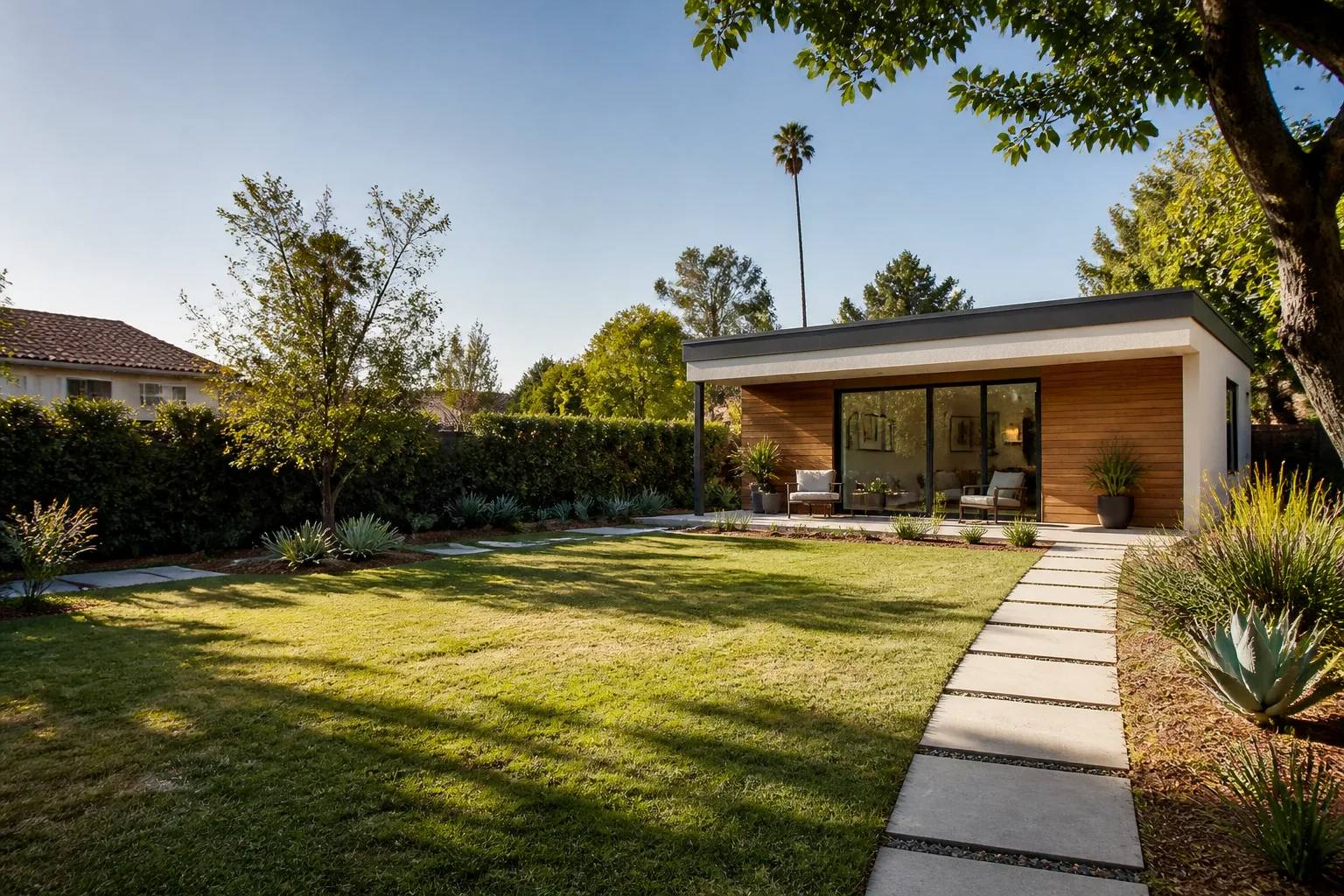
The typical all-in cost of a detached ADU in Citrus Heights in 2026 usually falls somewhere between the mid-$100,000s for a garage conversion or JADU and the mid-$400,000s for a larger custom detached unit, with most full-size detached prefab projects landing in the $250,000 to $350,000 range before site-specific utility work. The three numbers that move that range most are lot conditions (slope, soil, trees, demolition), the distance from the unit to existing sewer, water and electrical connections, and whether you build prefab or site-built. The written estimate sets the final price.
Table of Contents
- The full cost stack: hard, soft, and carrying costs
- Citrus Heights utility connections: SRCSD and SMUD line items
- Prefab vs. site-built cost at equivalent square footage
- Lot prep and how it varies across Citrus Heights parcels
- Fixed vs. negotiable: what you can actually move on a bid
- Garage conversions and JADUs: the lower-cost entry point
- How to compare two ADU bids line by line
- Common mistakes to avoid
What does an ADU actually cost in Citrus Heights? The full cost stack
An ADU budget has three layers, and most homeowners only hear about one. The construction number on the front page of a proposal is the hard cost, and it’s usually the most accurate part of any bid. The soft costs, which cover design, engineering, permits, and impact fees, and the carrying costs, which cover the months between signing and move-in, are where budgets quietly break. A useful 2026 reference for Citrus Heights needs all three.
Hard costs are the physical build: foundation, framing, roofing, siding, windows, doors, mechanical, electrical, plumbing, insulation, drywall, finishes, and the labor to install all of it. In this market, a typical detached prefab unit’s hard costs are largely locked by the manufacturer, while a site-built unit’s hard costs depend much more on the trades and the crew. Both include utility trenching from the unit to the existing house connection, which varies wildly by lot.
Soft costs are everything you pay before a shovel touches the ground:
- Design and drafting – architectural drawings and site plans, often bundled with permit coordination.
- Structural and civil engineering – required when a lot has slope, unusual soil, or a large tree near the footprint.
- Permit and plan-check fees – paid to the city, not the builder, and tied to the unit’s square footage and valuation.
- Impact and utility connection fees – the SRCSD and SMUD items we cover below.
- Title and survey work – sometimes required to confirm lot lines and easements.
Carrying costs are the softest of all and the most often forgotten. If you’re financing the build, that’s interest during construction. If you’re moving an aging parent into the ADU, that’s the overlap months before they’re settled. If you’re converting a garage, that’s the cost of relocating stored belongings and the loss of covered parking. These don’t appear on a bid, but they’re real money, and they belong in your spreadsheet from day one.
What are the Citrus Heights utility connection fees that don’t show up in generic cost guides?
Generic ADU cost guides list “utility connections” as a single line and move on. For a Citrus Heights build, that line needs to be broken open, because sewer and electrical connections here go through specific districts with their own fees and review timelines. Two names come up on nearly every ADU project in this city: SRCSD for sewer and SMUD for power. Neither appears in your average national calculator, and both can add meaningful money to a project budget.
On the sewer side, the Sacramento Regional County Sanitation District (SRCSD) reviews connection capacity for new dwelling units. A new ADU tied into the existing lateral usually needs a capacity review and, depending on flow calculations, may require a lateral upgrade or a separate connection. The fee is set by the district, not by your builder, so it’s a pass-through cost. Ask any contractor you’re considering where that line item sits in their proposal. If it isn’t there, that doesn’t mean it’s free – it means you’ll be paying it separately.
On the electrical side, SMUD handles the service connection. If your existing main panel has room for the ADU’s load, the connection is relatively straightforward. If it doesn’t, you’re looking at a service upgrade or a new meter, and that’s an electrical scope that changes the budget. Panel capacity is one of the most common surprises on older Citrus Heights homes, and it’s the item we confirm before any plans go final.
Water is typically a smaller line, handled through the local water district, but it still deserves an explicit number in your proposal. The pattern with all three of these – sewer, power, water – is the same: they’re district fees with their own review, and they aren’t negotiable. Budget them as fixed costs and confirm them early.
Prefab vs. site-built: what’s the real cost difference at equivalent square footage?
At the same square footage, prefab and site-built ADUs in Citrus Heights often land within $30,000 to $60,000 of each other on hard costs, but the spread depends more on site work and finish level than on the delivery method. Prefab isn’t automatically cheaper, and site-built isn’t automatically better. What differs is where the money goes and how much of the cost is fixed before you sign.
Prefab units are built in a factory against a known design and shipped as modules. That means the per-square-foot construction cost is more predictable, the schedule is shorter, and the quality is consistent because it’s built on a controlled line. What’s not fixed is the site work: foundation, utility trenching, crane access and hookup. On a flat Citrus Heights lot with good access, prefab can be very cost-efficient. On a tight lot with slope or a long utility run, the site work erodes that advantage fast.
Site-built allows a fully custom design and lets your plan adapt to the lot, which matters when a standard prefab module won’t fit the footprint you want. The trade-off is that site-built cost is more variable; the trades schedule, the finishes, and any change orders all shift the price after the contract is signed.
Here’s how the two compare across the main cost categories at equivalent size:
- Design and engineering: prefab is often bundled; site-built is a separate line and rises with custom detailing.
- Foundation: similar either way, but prefab may need specific foundation detailing for module loads.
- Construction: prefab is locked at the manufacturer’s price; site-built tracks local labor and materials.
- Site work and utilities: the same variables on either path – this is where the biggest swings live.
- Finishes: prefab offers a curated menu; site-built allows any finish you can specify.
- Schedule risk: lower with prefab, higher with site-built, and schedule risk is a carrying cost.
This is exactly where being an authorized builder for multiple prefab brands matters. Working with Abodu, Cover, and Dvele means we can quote three different prefab paths against a site-built option, so you’re comparing real numbers in the same market rather than guessing which approach is cheaper. From design through final inspection, we hold the whole comparison for you, which is the only way to see the true cost side by side.
How does lot prep drive ADU cost across Citrus Heights parcels?
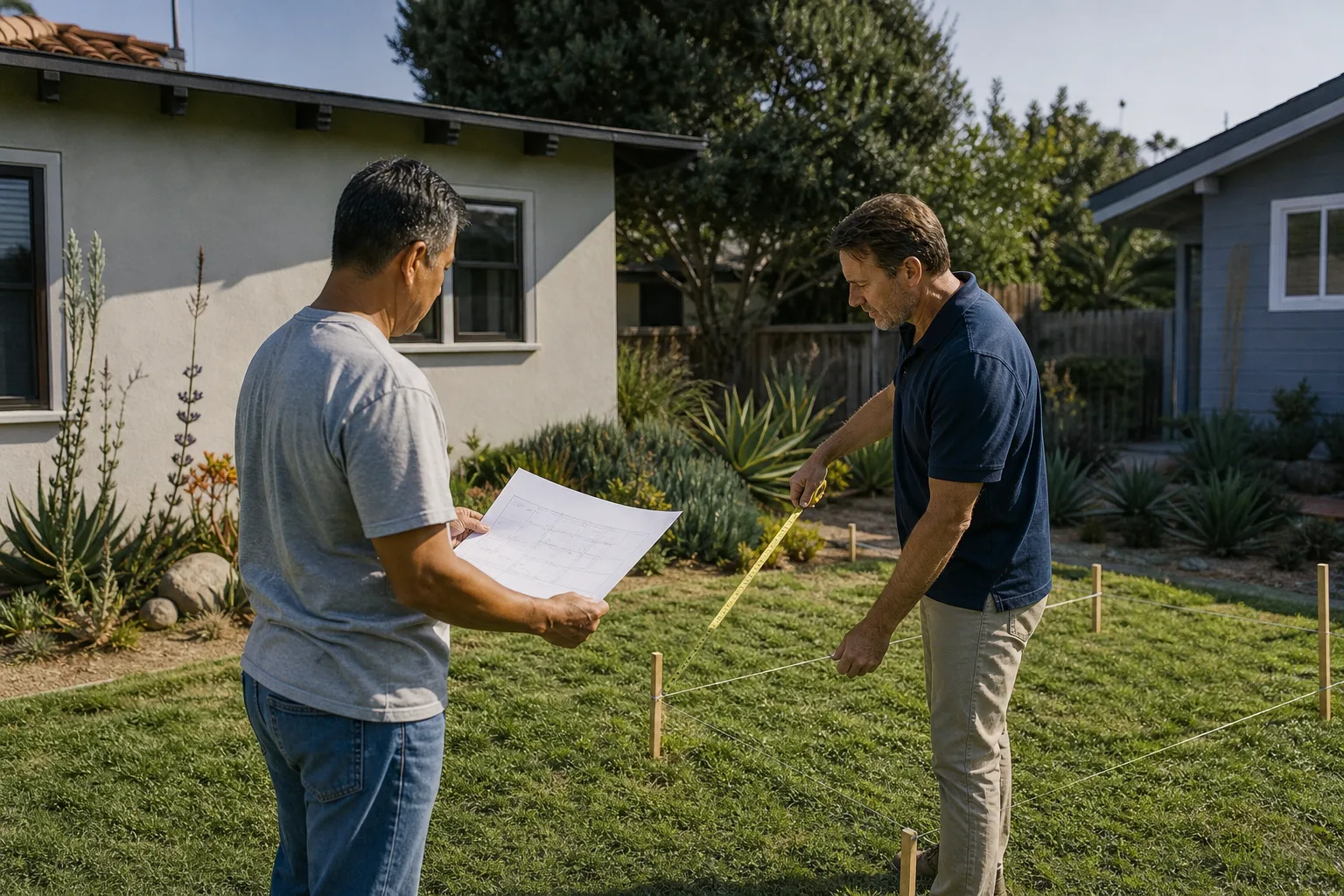
Lot prep is the least predictable line in any ADU budget and the one most often under-quoted. Two Citrus Heights lots with the same size and the same plan can differ by tens of thousands of dollars based on what’s under and around the footprint. Before you accept a bid, ask what the contractor has assumed about slope, soil, trees, and demolition; if those assumptions aren’t written down, the number you see is a placeholder.
Slope is the first variable. A flat lot needs minimal grading, and the foundation is straightforward. A lot with fall across the footprint needs retaining walls, engineered grading, or a stepped foundation, all of which add cost and engineering. Citrus Heights has plenty of both, and the difference shows up in the site plan before anything else is priced.
Soil is the second. Expansive clay soils common to the Sacramento Valley can require deeper footings or over-excavation. A geotechnical report is the cheapest way to find out; skipping it and hoping for the best is how foundation change orders happen. We confirm soil conditions as part of the design phase, not after the foundation is poured.
Tree removal is the third, and it’s often invisible on a bid until the arborist report comes back. A protected tree near the ADU footprint can require a permit, a replacement planting plan, and a redesigned footprint to keep the root zone intact. That’s a real cost and a real timeline item, and it should be scoped before permits are filed.
Demolition of an existing structure is the fourth. If you’re tearing down an old detached garage or a shed to build on its footprint, the demo, haul-away, and any hazardous material abatement (older structures sometimes contain asbestos) all land on the site work line. A garage conversion skips this entirely because the structure stays.
Which ADU cost items are fixed, and which are genuinely negotiable?
On a Citrus Heights ADU proposal, roughly 60 to 70 percent of the total is fixed by public agencies, manufacturers, or the physical site, and the rest is where a homeowner can actually negotiate. Knowing which is which keeps you from wasting leverage on the wrong line items.
These are fixed and not negotiable:
- Permit and plan-check fees – set by the city and tied to square footage and valuation.
- SRCSD sewer capacity and connection fees – district-set.
- SMUD electrical service fees – utility-set.
- School and impact fees where applicable – statutory, and the rules depend on the city and the lot.
- Manufacturer pricing on prefab modules – set by Abodu, Cover, or Dvele, depending on which you choose.
- Engineering and geotechnical reports – priced by the consultant, not the builder.
These are genuinely negotiable, and worth pushing on:
- Finish level – going from a designer kitchen to a durable, plain rental-grade kitchen is the single biggest lever.
- Footprint size – every square foot you add costs money to build, finish, and permit, so right-size the plan before you finalize.
- Prefab brand selection – comparing Abodu, Cover, and Dvele against each other on a like-for-like scope is a real cost lever, because each brand lands at a slightly different price.
- Site-built vs. prefab – the delivery method itself is a decision you can make once you see both quotes side by side.
- Utility routing – the distance from the unit to the existing connection can sometimes be shortened by repositioning the footprint, which reduces trenching and materials.
The written estimate should spell out every one of these as a separate line, with assumptions stated. If a bid groups them into a single “construction” figure, ask for the breakdown before you sign. Fixed pricing with no change orders only works when the scope is written down.
Can a garage conversion or JADU cut your ADU cost?
A garage conversion or a junior ADU is often the lowest-cost way to add a legal living unit on a Citrus Heights property, because the structure, foundation, and roof already exist. You’re paying for interior build-out, mechanical, electrical, plumbing, insulation, finishes, and permits, not for a new shell. For a homeowner who wants rental income or a place for an aging parent without a ground-up build, this is the entry point that makes the numbers work.
The cost structure is simply shorter. There’s no new foundation, no new roof, no new exterior siding, and no site work for a new footprint. The garage becomes living space, and the exterior mostly stays as-is. Where the budget goes instead is on the interior: converting a garage to a legal dwelling means meeting the energy code, adding a heating and cooling system, upgrading electrical to serve a full unit, and framing a sealed wall between the unit and the rest of the garage if you’re keeping any storage.
A JADU goes a step further. By code, a JADU is a smaller unit, typically created within the existing footprint of a single-family home or an attached structure, and it can share a bathroom or kitchen with the primary residence depending on the design. Because it’s a smaller scope, it can come in lower than a detached unit, and it’s often the fastest path to a legal, rentable space. We handle a junior ADU as a standalone project, from the initial feasibility check to final inspection.
If you want the tangible outcome – a rentable unit or a place for family – without the cost of a new structure, this is where we’d start the conversation. Turn your garage into rental income, and the budget shrinks on the lines that drive detached builds. Our garage conversion work is purpose-built for exactly this kind of project.
How to compare two ADU bids line by line
Two bids for the same ADU plan can differ by $80,000 and still both be honest. The difference is almost always scope, not profit. Here’s how to read them side by side so you’re comparing the same project.
- Put both proposals in the same categories. Rewrite each into hard, soft, and carrying costs, and see where one has a line the other doesn’t. A missing line is not a saving – it’s a cost you’ll absorb later.
- Check the site work assumptions. Look for slope, soil, trees, and demolition, and confirm that whoever quoted the low number actually scoped them. If site work is listed as “to be determined,” the price is not fixed.
- Confirm the utility line items. Both bids should show SRCSD and SMUD separately, with the fee amounts. If one bid omits them, add them in yourself before comparing totals.
- Confirm who pulls the permits. Permit acquisition is a named service at our company, and it’s included from design through final inspection. If a bid leaves permitting to you, ask what that actually means for your time and budget.
- Compare like-for-like finishes. A bid with hardwood and quartz is not the same project as one with vinyl and laminate, even at the same square footage. Normalize the finishes before comparing numbers.
- Ask what happens if a change order becomes necessary. The best proposals have a written change-order process and a fixed price for the defined scope. A vague process is a budget risk.
If you want a second set of eyes on a bid you’ve already received, call us and we’ll walk through it with you. That’s part of a free estimate, and it’s how we’ve seen homeowners avoid the biggest surprises. For a broader view of how the whole project fits together, see our ADU builders page for a full project walkthrough.
Common Mistakes to Avoid
- Budgeting from a per-square-foot number. A $/sq ft figure from a website doesn’t know your lot, your soil, your panel capacity, or your tree situation. It’s a starting point, not a budget. Build your actual number from line items, not a multiplier.
- Skipping the geotechnical report. Expansive clay soils are common in the Sacramento Valley, and a foundation designed without a soil report risks change orders. Pay for the report up front and design to it, rather than discovering the soil is a problem mid-build.
- Forgetting the SRCSD and SMUD items. Generic ADU cost guides don’t mention them, and contractors who don’t build here often don’t either. Confirm both are scoped and priced in the proposal before you compare totals.
- Assuming your electrical panel has room. Older Citrus Heights homes often have main panels that can’t carry a full ADU. Confirm panel capacity early, because a service upgrade is a real added cost.
- Under-insulating the garage conversion. A garage isn’t built to be lived in, so meeting energy code during conversion is a real line, not a trim. Skimping on insulation or HVAC means a unit that’s expensive to keep comfortable year-round.
- Letting one contractor coordinate another. When the designer, the permit expediter, and the builder are three separate businesses, the gaps between them become your problem. A project handled in-house from design through inspection closes those gaps.
- Treating the low bid as the fixed price. The low bid is often the one with the fewest line items scoped. Read the assumptions, not the total, and ask what’s excluded. The written estimate sets the final price.
When to Call a Professional
Call us when you’ve got a lot and a rough idea but no line-item budget yet, or when you’ve got two bids and can’t tell why they’re so far apart. Call us when you want to compare prefab against site-built at the same square footage, or when you’re weighing a garage conversion against a detached unit. Call us when you’re unsure what the city will require on your specific lot, or when a proposal you’ve received doesn’t mention SRCSD, SMUD, soil, or trees. Call when you want one team to own design, permitting, and construction from the first sketch to the final inspection. ADU Builder Citrus Heights offers free estimates in Citrus Heights and can walk you through the full cost stack on your parcel. Call (279) 321-4864. We answer 24/7. Fast dispatch from 7am to 7pm, Sunday through Friday. Our ADU builder Citrus Heights page has more on how we run a project from start to finish.
Frequently Asked Questions
Most detached ADUs in Citrus Heights land in the $250,000 to $350,000 range in 2026, with garage conversions and JADUs coming in lower and larger custom detached units reaching into the mid-$400,000s. The written estimate sets the final price, and the estimate is free. Call (279) 321-4864 for an exact quote for your lot.
They should be listed as separate line items in any honest ADU proposal. SRCSD reviews sewer capacity for the new unit, and SMUD handles the electrical service connection; both are district-set fees, not contractor charges. If a bid you’ve received doesn’t include them, they aren’t free – you’ll pay them separately. Ask each contractor to show them explicitly. Call (279) 321-4864 and we’ll walk through your proposal line by line.
Sometimes yes, sometimes no, and it depends more on site work than on the delivery method. Prefab prices are locked in by the manufacturer, which makes the construction line predictable, but that advantage shrinks on a lot with slope or a long utility run. Compare prefab and site-built at the same square footage and the same site conditions before deciding. Call (279) 321-4864 for a free side-by-side comparison.
Yes, but the site work changes the cost. Slope requires retaining walls, engineered grading, or a stepped foundation, and a protected tree near the footprint may require a permit and a redesigned plan. Those items are scoped during design, not after the foundation is poured. Call (279) 321-4864 to talk through your specific lot.
Our goal is fixed pricing with no change orders, which is why every scope, finish, and assumption is written into the estimate before you sign. Change orders only happen when you choose to change the scope. Call (279) 321-4864 for a written, line-item estimate – it’s free.
We handle the permits. Permit acquisition is a named service at our company, and in-house design and permit coordination means no hand-off between the designer, the permit expediter, and the builder. What the city will require on your specific lot depends on the lot and the plan, and we confirm that with the city’s planning or building department before plans go final. Call (279) 321-4864 to start the process.
The Bottom Line
The useful ADU number for a Citrus Heights homeowner in 2026 isn’t a per-square-foot figure – it’s a line-item estimate that accounts for hard costs, soft costs, and carrying costs, with SRCSD and SMUD fees shown separately and lot conditions scoped honestly. Prefab and site-built can land close together on price; the difference is where the money goes and how much is fixed before you sign. The way to compare bids is to normalize the scope, then look for what’s missing. That’s how you see the real number. Call (279) 321-4864. We answer 24/7. Fast dispatch from 7am to 7pm, Sunday through Friday.
Written by the team at ADU Builder Citrus Heights.